


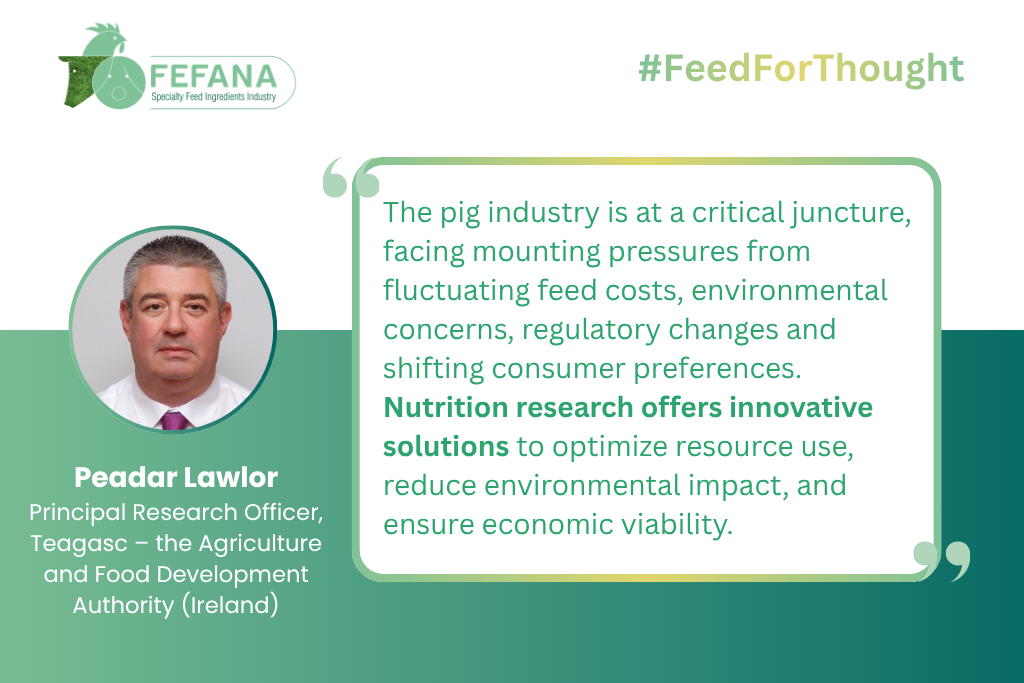
Feed For Thought: Peadar Lawlor, Principal Research Officer, Teagasc – the Irish Agriculture and Food Development Authority
5 May 2026
In this edition of Feed For Thought, FEFANA speaks to Peadar Lawlor, Principal Research Officer, Teagasc – the Agriculture and Food Development Authority (Ireland). Peadar holds a PhD, Masters and Bachelors in Agricultural Science, from University College, Dublin and he currently leads on a range of animal nutrition projects. This article represents the views of the author, Peadar Lawlor, and does not necessarily reflect the views or positions of FEFANA or indeed those of Teagasc.
Related to the findings of your research, what role does animal nutrition play in sustainable livestock production?
Animal nutrition directly influences animal health, growth, productivity, and the environmental footprint of farming operations. Our work has focused on optimizing feeding strategies, improving feed efficiency, improving health and reducing antimicrobial reliance, thereby, reinforcing the sustainability of pig production systems. Projects such as PigNutriStrat and MonoGutHealth, focused on optimizing the nutrition and management of suckling and newly weaned pigs. This work demonstrated that tailored early-life nutrition and management can greatly reduce antimicrobial usage, which is important since overreliance on antimicrobials contributes to antimicrobial resistance (AMR), and improves lifetime growth and feed efficiency in pigs. For example, additives such as probiotics and organic acids and/or formulation of post-weaning diets to have a low acid binding capacity can substitute for in-feed medication, demonstrating that nutrition can be a powerful tool in the fight against AMR while at the same time improving feed use efficiency and because of this reducing emissions from pig production. Our work with feed enzymes from projects ECO-FCE and PigZyme also demonstrates that their targeted dietary inclusion can also improve feed use efficiency.
What potential impact could research have on the future of sustainable livestock production?
The pig industry is at a critical juncture, facing mounting pressures from fluctuating feed costs, environmental concerns, regulatory changes and shifting consumer preferences. Nutrition research offers innovative solutions to optimize resource use, reduce environmental impact, and ensure the economic viability. Examples might include
a. Precision Feeding – tailoring diets to the specific nutrient requirements of individual pigs. Benefits include improved resource use efficiency, reduced feed cost per pig, N and P excretion as well as gaseous emissions.
b. Additives to improve feed efficiency (e.g. exogenous feed enzymes) and health (e.g. Probiotics, organic acids, prebiotics, enzymes). Benefits include improved resource use efficiency, reduced feed cost per pig, reduced mortality and morbidity, reduced antibiotic usage, reduced N and P excretion as well as gaseous emissions.
c. Alternative Protein and Energy Sources. Soybean meal is the dominant protein source in pig diets in the EU but can be linked to deforestation and biodiversity loss in major producing regions. Locally grown protein sources such as Faba Beans can be effective substitutes for imported SBM reducing carbon footprint. Future work on breeding and processing will improve digestibility, amino acid balance and help eliminate the negative effects of anti-nutritional factors. Insect meal, Algae also offer promise as protein sources, although more research on safety and improving nutritional quality is warranted.
d. By-products and Food Waste: Circular feed ingredients reduce waste and resource competition with human food.
e. Others: Ingredient substitution, preservation techniques other than drying, use of functional feed additives, reducing dietary crude protein etc.
What challenges do you envisage and what role can research play in finding solutions? Feel free to give examples from your own findings.
Pig production accounts for approximately one-third of global meat consumption. However, the sector faces increasing challenges related to sustainability, including environmental impact, resource scarcity, economic viability, animal health, and concerns such as antimicrobial resistance.
Key Challenges
1. Environmental Impact
a. Feed Production and Manure Management: Feed production and manure management are consistently identified as the primary environmental hotspots in pig production systems.
b. Reliance on Imported Feed Ingredients: Imported soybean meal remains the dominant protein source in pig diets globally but its use is often linked to deforestation, biodiversity loss, and high carbon usage and so the practice increases the environmental and economic vulnerability of pig production.
c. Nutrient Excretion and Pollution: Inefficient nutrient utilisation leads to excess nitrogen and phosphorus in manure, contributing to eutrophication of water bodies and increased ammonia emissions.
2. Economic Pressures
Feed accounts for up to 70% of total production costs in pig production. Volatility in global commodity markets, geopolitical instability, and supply chain disruptions have huge impacts on economic sustainability of pig production.
3. Animal Health and Welfare
There is pressure to reduce antibiotic use in pig production due to it’s link with AMR. However, disease control is still a significant challenge, especially with ever increasing litter sizes in pigs. These large litters also bring welfare concerns.
4. Regulatory and Societal Pressures
Stricter environmental, animal welfare and antibiotic use regulations mean that producers must balance compliance with profitability and market access.
The Role of Nutrition Research in Addressing Sustainability Challenges
- Formulating low crude protein diets based on NE and balanced for SID amino acid content improves feed efficiency and growth while reducing environmental impact.
- Locally grown protein ingredients (e.g. faba bean) or circular ingredients as an alternative to imported Soyabean meal reduces reliance on imported feed, lowers the carbon footprint, and enhances feed system autonomy.
- The use of functional feed additives (e.g. organic acids and exogenous enzymes can improve nutrient utilization, gut health, and reduce ammonia emissions.
- Integrating LCA methodologies with nutrition trials to quantify the environmental trade-offs and synergies of nutritional interventions. This can support evidence-based decision-making for both producers and policymakers.
- Dissemination of research results must improve to drive wider adoption.
Do you foresee closer ties between academia and industry and in what way?
It is inevitable that ties between academia and industry will become closer in the coming years. This is essential to ensure that innovations necessary to ensure a sustainable future for pig production occur. More research will be co-designed and co-funded thereby ensuring scientific rigor, commercial relevance, rapid adoption, and scalability.
- Innovations in for example precision nutrition, alternative feed ingredients as well as sustainability metrics should/will be developed jointly to ensure applicability, relevance, and robustness.
- Regulatory and market challenges will in the future have to be addressed through more unified advocacy and standard-setting (Safety, efficacy, sustainability). This will not always be plain sailing as researchers and research organisations will always have to be seen as independent.
- It is critical that industry personnel are educated and upskilled to meet the demands of a rapidly evolving industry. Academia will have a key role to play in this regard to ensure that personnel are equipped with the latest science and technology. This will range from postgraduate training (Masters, PhD) to in-service training for existing personnel.
A combination of scientific rigor and industry pragmatism is necessary to meet the challenges facing global animal production.
What would your advice be to European policymakers as they consider the best ways to support sustainable livestock production?
a. Reduce Reliance on Imported Soya
- Incentivise the cultivation of protein crops (e.g., peas, lupins, broad beans) within the EU.
- Support research and innovation in alternative feed sources, including circular food system approaches (e.g., food waste, crop residues).
- Consider restrictions on feed imports linked to deforestation
b. Support Feed Sector Competitiveness
As feed represents ~70% of total production costs for pig producers, policy must address all factors affecting feed cost; including trade, input prices, and regulatory burdens, to ensure the sector’s competitiveness.
c. Invest in Research and Innovation
EU-funded projects can help develop and advance sustainable livestock practices. Policymakers should increase funding for research on sustainable pig/animal production, including improving feed efficiency, use of local and circular feed ingredients, increased use of former foods and with particular focus on reducing reliance on imported Soya.
d. Encourage Knowledge Transfer and Farmer Support
Encourage and expand knowledge exchange networks which can be highly effective in disseminating best practices. Also, national advisory/extension services should be promoted so that they can enable farmers to adopt innovative and sustainable practices.
e. Reward Sustainability
Transitioning to sustainable pig production requires investment, but a fair return for farmers is not certain. Policymakers should ensure that:
- Public procurement standards encourage the use of EU produced meat where it is shown that production standards are higher and therefore incur a greater cost to produce.
- There is a fairer return along the value chain. Greater transparency is required in this regard since in times of crisis it the primary producer who currently suffers.
f. Facilitate Access to Finance
Increasing sustainability comes at a financial cost and often requires investment.
- Financial support and access to low interest loans may be required.


Want to join FEFANA?
Become a member.
Want to know more about FEFANA ?
Contact us