


Feed For Thought: Jeroen Degroote, Department of Animal Sciences and Aquatic Ecology, Ghent University, Belgium
22 June 2026
In this edition of Feed For Thought, FEFANA speaks to Prof. Jeroen Degroote, Department of Animal Sciences and Aquatic Ecology, Ghent University, Belgium. Jeroen coordinates the pig and poultry research group at LANUPRO, Ghent University, where his team develops data driven nutrition strategies to improve animal health, nutrient efficiency and sustainability. The work combines digestive physiology, quantitative animal nutrition and modern data technologies, with strong experience in executing in vivo nutritional experiments and animal monitoring. This article represents the views of the author, Jeroen Degroote and does not necessarily reflect the views or positions of FEFANA or indeed those of Ghent University.
Related to the findings of your research, what role does animal nutrition play in sustainable livestock production?
In my research, sustainable livestock production plays a crucial role in defining my research questions in the field of animal nutrition. My focus is mainly to improve sustainability by harnessing precision feeding algorithms and AI-driven tools. Currently, formulating diets often relies on broad assumptions rather than farm-specific performance data. This creates inefficiencies, as nutrient needs and intake curves aren’t fully aligned with the real growth patterns and health statuses on each farm. My work focuses on addressing this gap, moving beyond simple least-cost formulations toward multi-objective diet optimization. By integrating sustainability goals, we can shift the focus to the most efficient production of animal protein. Additionally, this requires flexible data exchange and privacy-preserving technologies like federated learning. My aim, together with colleagues, is to make such advanced optimization accessible, allowing farms to have access to performant decision support tools.
What potential impact could research have on the future of sustainable livestock production?
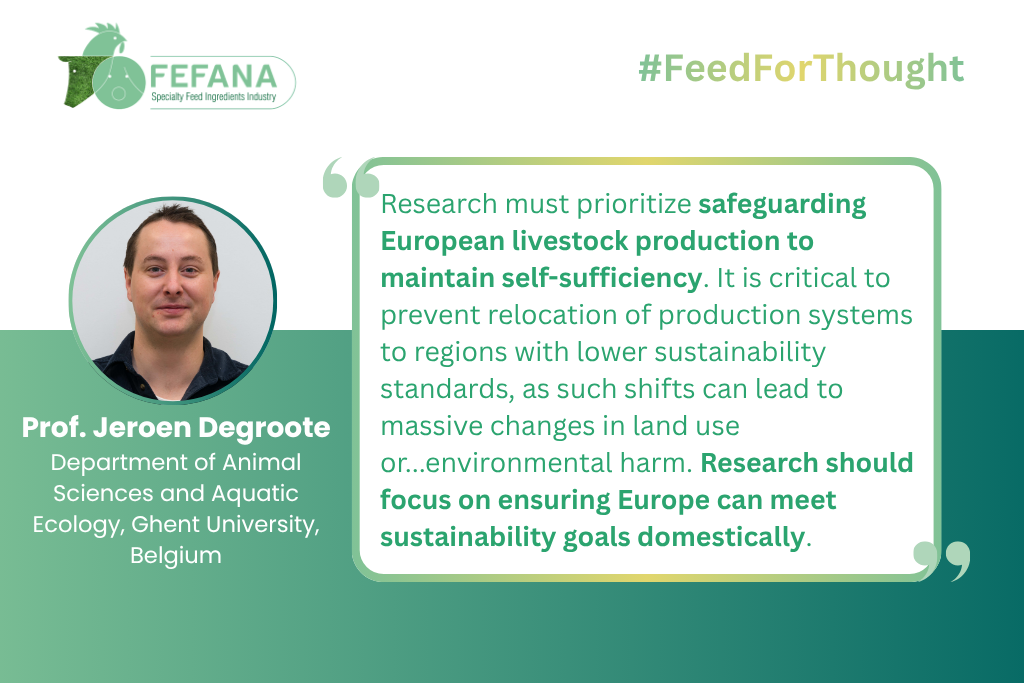
Research must prioritize safeguarding European livestock production to maintain self-sufficiency. It is critical to prevent relocation of production systems to regions with lower sustainability standards, as such shifts can lead to massive changes in land use or other factors that effect environmental harm. Research should focus on ensuring Europe can meet sustainability goals domestically.
In terms of feed, valorizing co-products is key to creating circular systems. Feed additives will be essential not only for digestion, like phytases, but also for sustainably produced amino acids, minerals, and vitamins, all sourced within Europe. This strengthens local production and resilience.
Lastly, data-driven tools, like precision feeding algorithms, are vital. These tools have the potential to reduce nutrient waste. However, the biggest threshold is to allow these systems to be flexible towards individual farms while also being scalable and easy to be service, improve and control. And so, in fact, a lot of research needs to be performed at a much larger scale in order to facilitate the implementation of current knowledge on decision feeding. Research across these fronts of circular feedstuff, sensible feed additives and scalable precision feeding will ensure Europe’s livestock production becomes more sustainable, without offshoring or compromising global impact.
What challenges do you envisage and what role can research play in finding solutions? Feel free to give examples from your own findings.
The main challenge I foresee is the pace at which we must provide solutions. Legislation and sustainability targets are evolving rapidly, becoming stricter by the day, and research must keep up with this tempo. While solutions are possible and innovation will drive improvements, timing is critical. If research lags behind, we risk not meeting these evolving demands in time. This could lead to distortions and the relocation of production systems outside Europe, undermining sustainability goals. We must ensure that research delivers results at the speed needed to safeguard sustainable production of animal protein within Europe. Maintaining feed availability and sustainable production depends on matching this legislative pace with equally rapid research progress.
Do you foresee closer ties between academia and industry and in what way?
Closer ties between academia and industry, especially in an applied field like animal nutrition, are welcomed. Currently, many interactions are bilateral, such as product testing or supporting specific product development. These collaborations are valuable but often don’t deliver the scale and speed needed for rapid sustainability progress at a more global level. In bilateral interactions, we must ask the right questions, focusing on realistic impact, faster valorization, and scaling efficient solutions.
On a larger scale, more profound step changes will require industry to engage in bigger research programs, with co-funding and deeper collaboration. As industry partners work more closely with academia, they must also collaborate among themselves. This means sharing research, intellectual property, and results within broader projects This is posing challenges at its own, but will enable more transformative progress. In essence, achieving industry-wide sustainability will require both bilateral focus on rapid innovation and large-scale joint efforts for step changes. Both will be essential, but industry must be ready for both collaboration and shared outcomes.
What would your advice be to European policymakers as they consider the best ways to support sustainable livestock production?
Concerning research, my advice to European policymakers is twofold. First, I recommend offering multiple tracks of innovation grants that allow for different scales and speeds. We currently have a gap in smaller, easy-to-obtain funds to quickly explore initial ideas. For instance, with AI and large language models creating new opportunities, we don’t always need large projects with multiple companies to screen small ideas. In addition, policymakers should look within their own systems and identify which types of data and information can be captured, shared, and reused more easily across European research. Second, while the broader funding system works well at regional or European levels, applied fields like animal nutrition often lose out to well-funded areas like human medicine. We must ensure that sustainable feed and food remain top priorities as well.
Concerning industry, I advise policymakers to carefully balance regulatory processes and trade policies. Companies need a predictable environment and enough time to adapt to new measures. Due diligence trade system (e.g. EUDR) are a painful procedure, but policymakers should also investigate where these systems can improve the position of European traders and manufacturers in the agrifood business.


Want to join FEFANA?
Become a member.
Want to know more about FEFANA ?
Contact us