


Feed For Thought: David Yáñez-Ruiz, Research Professor at Spanish National Research Council
20 April 2026
In this edition of Feed For Thought, FEFANA speaks to Dr David Yáñez-Ruiz, Research Professor at the Spanish National Research Council in Granada, Spain. He manages a team of 15 working on nutritional management in ruminants to improve the sustainability of livestock production systems. This article represents the views of the author, David Yáñez-Ruiz, and does not necessarily reflect the views or positions of FEFANA.
Related to the findings of your research, what role does animal nutrition play in sustainable livestock production?
Animal nutrition plays a very relevant role in promoting sustainable livestock production. It can be considered the “master lever” in agricultural management because it simultaneously dictates biological efficiency, environmental footprint, and the economic viability of the farm. I would support such statement across three principles:
1) Financial Sustainability, optimizing the Largest Cost. In the most intensive livestock systems, feed accounts for 60-70% of total production costs. Precise nutrition is the primary tool for protecting profit margins (examples of improvement include boosting the Feed Conversion Ratio, applying Digital technology/precision feeding to reduce waste and the self-alternative feedstuffs like by-products).
2) Environmental Sustainability, Reducing the Footprint. Nutrition is the most direct way to mitigate the environmental impact of livestock, particularly regarding resource use (land and water) and emissions (i.e. enteric methane emissions).
3) Social Sustainability, by ensuring adequate Animal Welfare and human Food Security.
What potential impact could research have on the future of sustainable livestock production?
Research is already having a great impact through testing and developing technology that can make livestock production more sustainable. In animal nutrition the development of feed additives for ‘microbiome engineering’ have shown potential to reduce enteric methane emissions by 30-40% or improve feed conversion ratio quite substantially. Also, valorizing the by-products from the human food industry into feed ingredients for livestock is both reducing production costs and GHG emissions as less fertilizers are needed to produce animal feeds. The use of digital technology and artificial intelligence offer a massive prospect for future improvements in feed efficiency and animal health and welfare.
What challenges do you envisage and what role can research play in finding solutions?
We face multiple challenges. Funding to cover the costs of animal trials that last long enough to ensure robust results is key to deliver solutions. Before that, basic research on developing some principles, like identifying novel molecules or proxies for high efficiency. To address such challenges specific funding programs are needed.
Another challenge relates to the diversity and complexity of the livestock production systems in Europe. Developing solutions that fit all systems is not possible and therefore specific programs need to be in place. Indoor and outdoor grazing systems require different approaches when it comes to research in animal nutrition.
As we are experiencing, climate change is probably one of the main challenges in our society, which impacts largely on animal production. Developing solutions in animal feeding for different climate change scenarios across Europe is going to be difficult and we need to be prepared as the changes are already occurring at a faster pace that we initially anticipated.
Do you foresee closer ties between academia and industry and in what way?
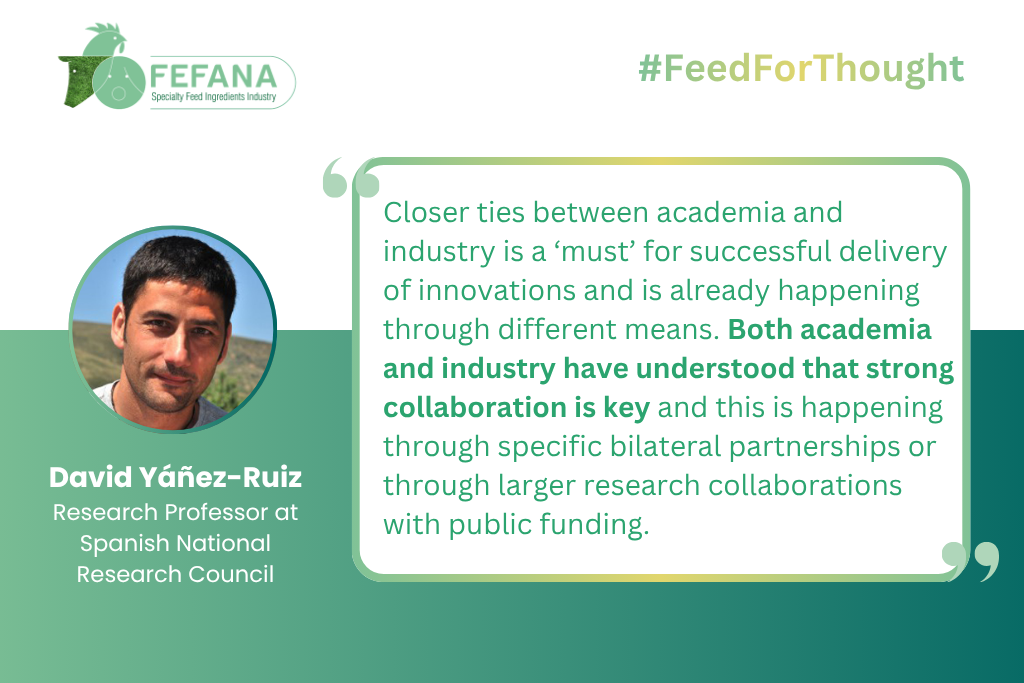
Definitely. This tie is a ‘must’ for successful delivery of innovations and is already happening through different means. Both academia and industry have understood that strong collaboration is key and this is happening through specific bilateral partnerships or through larger research collaborations with public funding. This is the case in EU funded projects like Re-Livestock (Faciliting Innovations for Resilient Livestock Farming Systems, https://re-livestock.eu), in which we are testing novel feed additives for both mitigation and adaptation, low carbon footprint feeds and technologies to reduce waste in animal feeding.
What would your advice be to European policymakers as they consider the best ways to support sustainable livestock production?
There are many fronts in which I would suggest placing attention. As discussed above, acknowledging the diversity of production systems in Europe is very important. Also, the process to get approval for novel feed ingredients through EFSA needs to be revisited and make it simpler and more accessible for SMEs. Currently, only large companies can afford to invest the time and money to go through EFSA dossier applications.
I would also recommend developing campaigns to improve the knowledge of consumers (especially younger generations) on the importance of livestock in our society, not only in nutritional aspects (proving essential macro and micronutrients) but also in shaping our landscapes, maintaining ecosystems, preventing wildfires, which affect every community across Europe.


Want to join FEFANA?
Become a member.
Want to know more about FEFANA ?
Contact us