


Feed For Thought: Mohammad Ramin, Associate Professor, Swedish University of Agricultural Sciences
9 July 2026
In this edition of Feed For Thought, FEFANA speaks to Mohammad Ramin, Associate Professor, Swedish University of Agricultural Sciences (SLU). Mohammad is an animal scientist specializing in dairy cow nutrition, feed efficiency, and greenhouse gas emissions from livestock systems. His research focuses on applying innovative measurement techniques, including the GreenFeed technology, to quantify gas emissions and identify feed efficient cows while advancing more sustainable dairy production. This article represents the views of the author, Mohammad Ramin and does not necessarily reflect the views or positions of FEFANA or indeed those of SLU.
Related to the findings of your research, what role does animal nutrition play in sustainable livestock production?
Animal nutrition plays an important role in sustainable livestock production because it influences animal health, productivity, economic efficiency, and environmental sustainability. Providing animals with balanced diets that meet their nutritional requirements helps improve growth, reproduction, milk production, and overall performance. Nutrition also has a significant impact on the environmental footprint of livestock systems. Efficient feeding strategies improve feed conversion, allowing animals to produce more output from the same amount of feed. This reduces the use of resources such as land, water, and energy needed for feed production. Proper diet formulation can also decrease methane emissions, nitrogen excretion, and nutrient losses that contribute to air, soil, and water pollution. Furthermore, the use of alternative feed ingredients, agricultural by-products, and locally available feed resources can enhance sustainability by reducing dependence on conventional feed materials and lowering transportation related emissions. Precision feeding practices, which provide nutrients according to the specific needs of animals, help minimize feed waste and improve nutrient utilization. Overall, animal nutrition is a key component of sustainable livestock production because it supports animal welfare, improves productivity, reduces environmental impacts, and enhances the efficient use of natural resources. Effective nutritional management is therefore essential for ensuring long term sustainability in livestock systems. Furthermore, the inclusion of targeted feed additives, including methane inhibitors and other rumen modifying compounds, can significantly reduce enteric methane emissions, offering an effective nutritional strategy for mitigating the environmental impact of livestock production.
What potential impact could research have on the future of sustainable livestock production?
Research has the potential to significantly improve the future of sustainable livestock production by developing innovative feeding strategies, improving animal health, and reducing environmental impacts. Advances in nutrition, genetics, and management practices can increase productivity while using fewer resources such as feed, water, and land. Research can also help reduce greenhouse gas emissions, improve feed efficiency, and identify sustainable alternative feed sources. Additionally, new technologies and precision livestock farming tools can enhance animal welfare and resource management. Overall, research provides the knowledge and solutions needed to produce animal products more efficiently while ensuring environmental sustainability and food security for a growing global population. Furthermore, research can help reduce greenhouse gas emissions, improve feed efficiency, and identify sustainable alternative feed sources. Research is also playing an important role in evaluating and developing feed additives that can reduce enteric methane emissions, providing practical nutritional solutions to lower the environmental footprint of livestock production.
What challenges do you envisage and what role can research play in finding solutions? Feel free to give examples from your own findings.
One of the major challenges facing sustainable livestock production is the need to increase food production while reducing environmental impacts such as greenhouse gas emissions, nutrient pollution, and resource use. Other challenges include rising feed costs, limited availability of quality feed resources, climate change, and maintaining animal health and welfare. Research plays a crucial role in addressing these challenges by developing innovative and practical solutions. For example, research on animal nutrition can identify alternative feed ingredients and improved feeding strategies that enhance feed efficiency and reduce waste. In my findings, optimized nutrition improved nutrient utilization, which can help lower feed costs and reduce the environmental footprint of livestock production. Research can also support the development of precision feeding technologies that provide animals with nutrients according to their specific needs, improving productivity while minimizing emissions and nutrient losses. Overall, continued research is essential for creating sustainable livestock systems that balance productivity, profitability, animal welfare, and environmental protection.
Do you foresee closer ties between academia and industry and in what way?
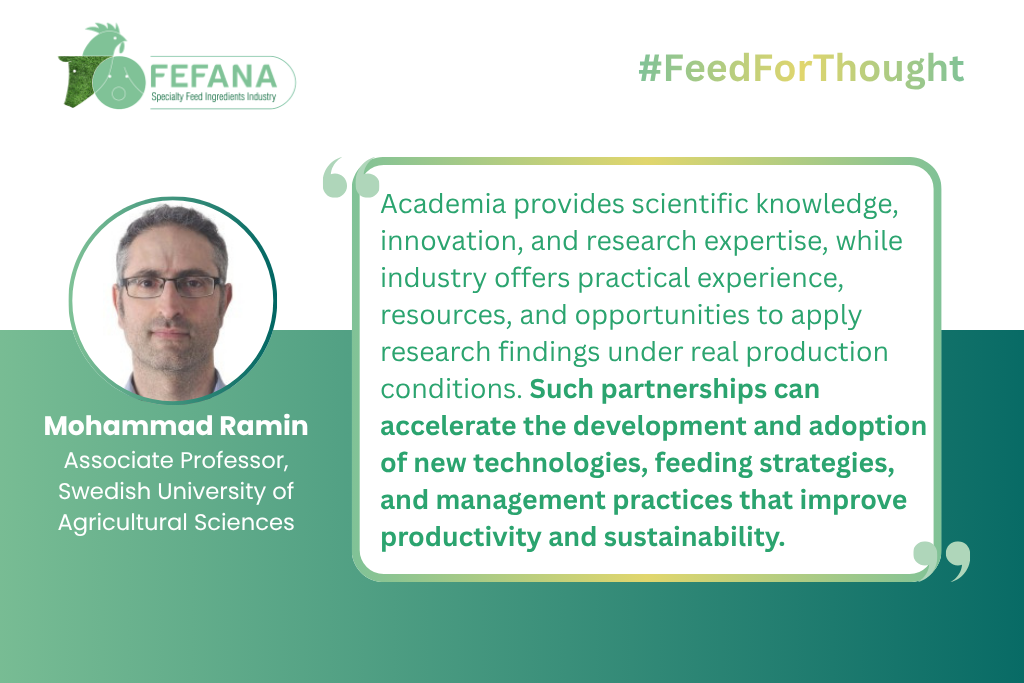
Yes, I foresee closer ties between academia and industry in the future, particularly in the field of sustainable livestock production. Many of the challenges facing the livestock sector require practical, science-based solutions that can only be achieved through collaboration between researchers and industry stakeholders. Academia provides scientific knowledge, innovation, and research expertise, while industry offers practical experience, resources, and opportunities to apply research findings under real production conditions. Such partnerships can accelerate the development and adoption of new technologies, feeding strategies, and management practices that improve productivity and sustainability. For example, research findings on animal nutrition can be tested and implemented on commercial farms to evaluate their effectiveness and economic feasibility. Industry feedback can also help researchers focus on solving real world problems and ensure that research outcomes are relevant and applicable. Therefore, stronger collaboration between academia and industry will be essential for advancing sustainable livestock production and addressing future challenges. Collaboration between academia and industry will also be important for testing and implementing methane reducing feed additives under commercial farming conditions, helping to ensure their effectiveness, practicality, and adoption within sustainable livestock systems.


Want to join FEFANA?
Become a member.
Want to know more about FEFANA ?
Contact us