


Feed For Thought: Nadia Everaert, Department of Biosystems, KU Leuven, Belgium
18 May 2026
In this edition of Feed For Thought, FEFANA speaks to Prof. Nadia Everaert, Department of Biosystems, KU Leuven, Belgium. Nadia is a professor at the Division of Animal and Human Health Engineering, Department of Biosystems, KU Leuven, Belgium, and also Head of the Nutrition and Animal-Microbiota EcoSystems (NAMES) Lab. Her research group studies microbiota colonization, gut health, and gut function in monogastric species such as poultry and pigs. This article represents the views of the author, Nadia Everaert and does not necessarily reflect the views or positions of FEFANA or indeed those of KU Leuven.
Related to the findings of your research, what role does animal nutrition play in sustainable livestock production?
Animal nutrition plays a major impact on sustainable livestock production: which ingredients are used and where they come from have an important environmental footprint. On the other hand, feed formulation models used in practice of course need to consider the economic value. This means it is not always a match between environmental and economic targets.
In our ongoing research, we evaluate ‘new’ feed ingredients using in vitro and in vivo models. These ingredients should have a lower environmental impact. Our aim is to evaluate these alternative feed ingredients (in the case of byproducts, for example, we tested apple pomace in vitro and in vivo) and see what their effect is on the performance and gut health of the animals. When we can collaborate with companies, we can also include the economic aspect when we screen different alternatives.
What potential impact could research have on the future of sustainable livestock production?
What is of value in research is that we can focus on specific aspects (e.g. the performance evaluation, digestibility, gut health effect) to really explore which ingredients should consider more attention, even when their cost is high. Having this knowledge remains important. Then of course for other types of research, we can combine all aspects of sustainability (environmental, social, economic) by collaborating with other experts and with feed mills or co-product suppliers.
We are now starting a project that trains new researchers in this field of sustainable livestock production (Marie Curie ITN project entitled FEATURE). They are evaluating alternative feed ingredients by in vitro methods and in vivo trials, product quality measurements (e.g. milk, cheese, meat, eggs), and calculating the environmental impact, economic potential, and evaluating strategies to connect with policymakers. Collaboration with industry partners is also foreseen and important for the success of the project, which in turn will help researchers later work in companies and further develop the future of sustainable livestock production.
What challenges do you envisage and what role can research play in finding solutions? Feel free to give examples from your own findings.
The challenges facing sustainable livestock production include having the economic drive, to convince the entire sector to choose to implement the sustainable option (even when economically it is not the best solution), and convincing policymakers to support the sector in consistently choosing more sustainable solutions. Furthermore, ensuring these sustainable solutions complement animal welfare can also be a challenge.
From our research side, the challenge is to make sure we are focusing and investigating relevant topics that can have an impact in practice. We are doing research on fundamental topics without a direct application at the end of a project (e.g. microbiota transplantations) and additionally we do more applied research (e.g. feed structure for optimal gut health). We need to make sure that we always have projects in these areas. We need to strike a balance between fundamental research and applied research to help bring innovation into everyday practice.
Also, for our research, we are often only looking at one part: for example, I mainly focus on evaluating coproducts/byproducts and their effects on gut health, but I also need to collaborate with other colleagues (internally and externally) to work on life cycle assessment analyses or economic evaluations, for example. That means emphasizing multidisciplinary research, and that is a challenge to get all these skills (for 1 person), or to collaborate well so you succeed in your evaluation from performance to health, and from sustainability on an economic, environmental and social level. And additionally, we should always make sure that our research outcomes are seen by people working in the sector.
Do you foresee closer ties between academia and industry and in what way?
Absolutely. As mentioned regarding the FEATURE project, we want to know which coproducts/byproducts are available, what their cost is to make sure that the researchers can do the socioeconomic evaluation, and to make sure we test the right ingredients in new feed formulations. Collaboration with industry is therefore essential.
We are also involved in two projects in Flanders where we only get a final part of our subsidy if we can prove that the industry is using our project outcomes, which can help enable us to work on relevant (for practice, for industry) topics. Another project is on feed structure and pellet quality (Optifest), in which the use of new feed ingredients and their effects on gut health, performance and welfare parameters are analyzed. We do farm visits/samplings as we need to make sure that the feed companies implement the newly obtained knowledge.
Therefore, in several types of projects (e.g. financed by local funding agencies or by the EU), we are encouraged to collaborate with industry or farmers. We go from projects where we have an advisory board composed of people from industry (who may contribute financially), to projects where a part of the research is done in industrial facilities or on the farm.
What would your advice be to European policymakers as they consider the best ways to support sustainable livestock production?
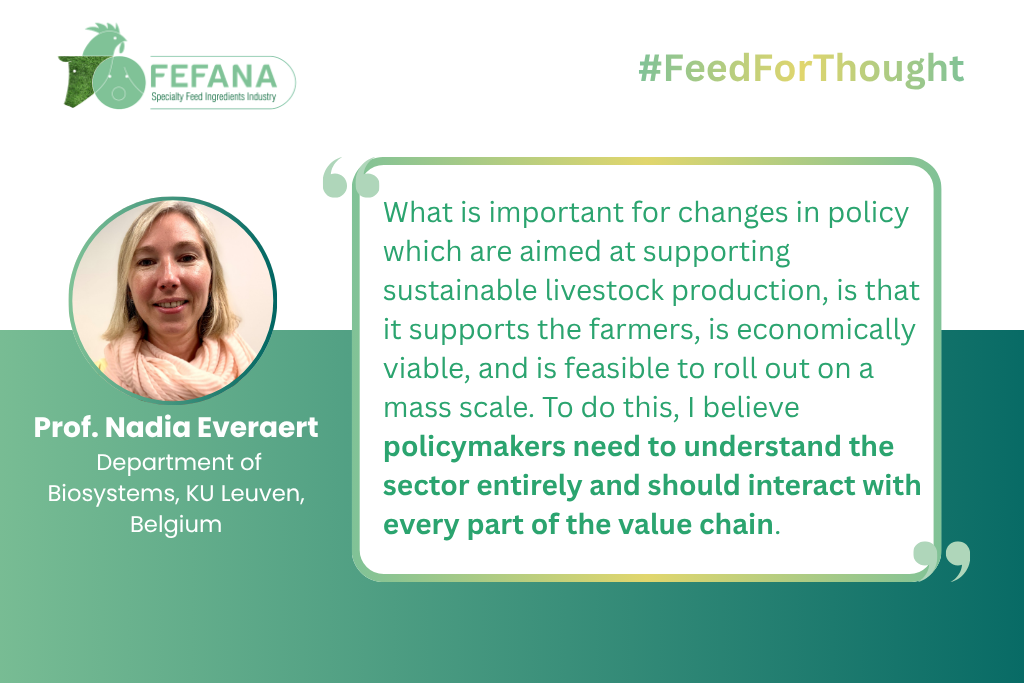
Whilst I am not a politician, I do think that what is important for changes in policy which are aimed at supporting sustainable livestock production, is that it supports the farmers, is economically viable, and is feasible to roll out on a mass scale. To do this, I believe policymakers need to understand the sector entirely and should interact with every part of the value chain.


Want to join FEFANA?
Become a member.
Want to know more about FEFANA ?
Contact us